
Programme/Program
9h00-9h30 : Ouverture institutionnelle/Opening remarks
- Stéphane Roussel : Président du Conseil des Gouverneurs de l’Hôpital Américain de Paris.President of the Board of Governors, American Hospital of Paris.
- Gérard Friedlander, MD, PhD: Ancien doyen de la faculté de médecine René Descartes ; délégué général de la Fondation Université Paris Cité.Former Dean of the René Descartes Medical School; Delegate General at the Université Paris Cité Foundation.
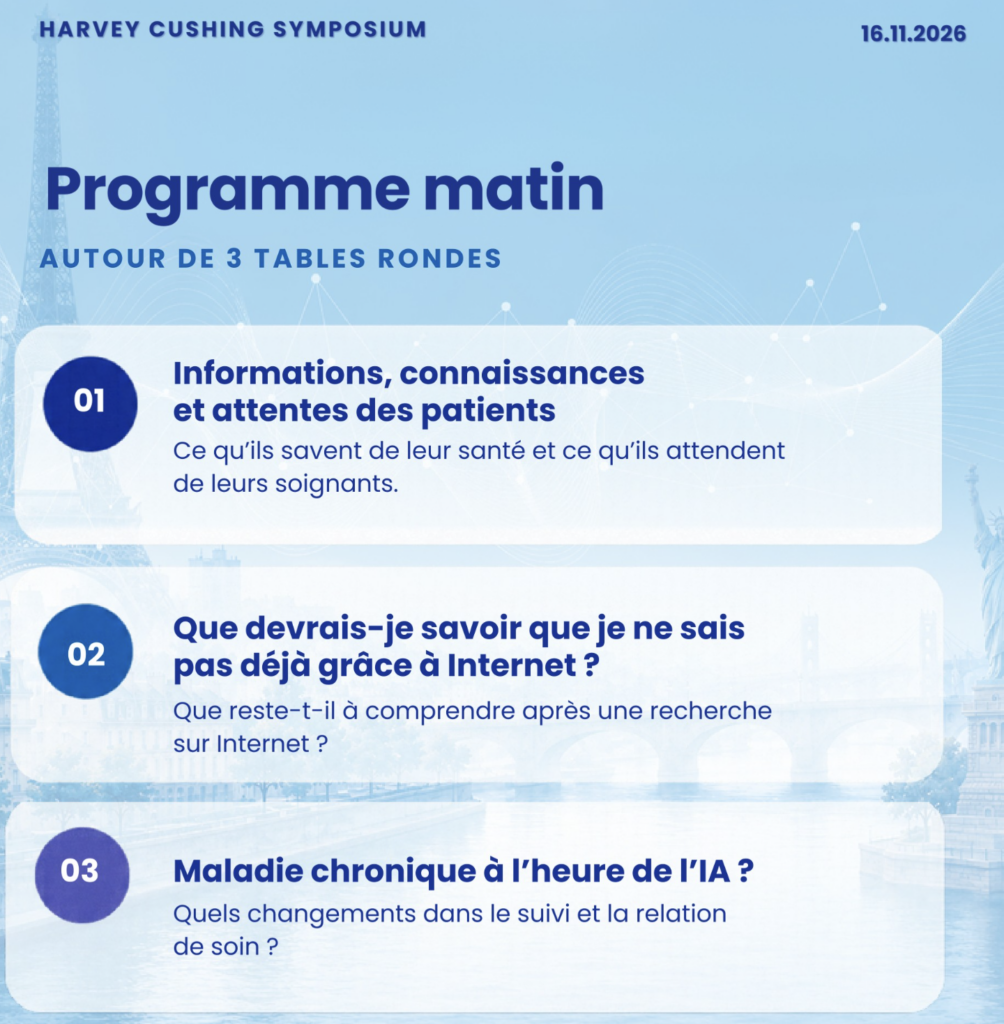
- 9h30-10h15 : Information, connaissances et attentes des patient/Landscape of patient knowledge, information, expectations
- Que savent vraiment les patients sur leur santé, et qu’attendent-ils de leurs soignants à l’ère du numérique ? Quatre experts de rang international, en psychologie de la santé, médecine numérique, décision partagée et représentation des patients, confrontent données de terrain et expériences vécues, des quelque 65 000 patients de la cohorte ComPaRe aux grandes enquêtes nationales. Une table ronde pour repenser la relation soignant-soigné à la lumière de ce que les patients savent, ignorent… et refusent./ What do patients really know about their health, and what do they expect from their healthcare providers in the digital age? Four world-renowned experts in health psychology, digital medicine, shared decision-making, and patient advocacy compare real-world data and lived experiences, ranging from some 65 000 patients in the ComPaRe cohort to large-scale national surveys. A round-table discussion to rethink the healthcare professional-patient relationship in light of what patients know, do not know… and refuse to accept.
Modérateur / Chair
Christian Saout
Ancien membre du Collège de la Haute Autorité de santé.
Former member of the Board of the French National Health Authority.
Intervenants / Speakers
- Viet-Thi Tran, MD, PhDProfesseur d’épidémiologie à Université Paris Cité et à l’Assistance publique–Hôpitaux de Paris (AP-HP).Professor of Epidemiology at Université Paris Cité and Assistance Publique–Hôpitaux de Paris (AP-HP).
- Angie Fagerlin, PhDProfesseure et directrice du département des sciences de la santé des populations, Spencer Fox Eccles School of Medicine, Université de l’Utah.Professor and Chair, Department of Population Health Sciences, Spencer Fox Eccles School of Medicine, University of Utah.
- Jean-Pierre Thierry, MDMédecin spécialisé en santé publique et en informatique de santé.Physician specializing in public health and health informatics.
10h15-11h00 : Que devrais-je savoir que je ne sais pas déjà grâce à Internet ?/ What should I know that I don’t already know from my web search?
Et si la vraie fracture en santé n’était pas l’accès à l’information, mais la capacité à savoir ce qu’on ne sait pas encore ? Des pionniers de la décision partagée, de l’éthique médicale et de la littératie en santé explorent ensemble l’angle mort de la relation soignant-soigné : ce que les patients ignorent sans le savoir, de la recherche sur Internet aux angles morts cognitifs. Une table ronde pour repenser ce que signifie être un patient vraiment informé et les obligations éthiques des médecins à l’ère de l’Intelligence artificielle/What if the real gap in healthcare is not access to information, but knowing what you do not know yet? Pioneers in shared decision-making, medical ethics, and health literacy come together to explore the blind spot at the heart of the patient-provider relationship: what patients do not know they are missing, from Internet searches to cognitive gaps. This panel will reconsider what it truly means to be an informed patient and the ethical obligations of physicians in the age of AI.
Modérateur / Chair
Joseph J. Fins, MD, DHL, DMSc, MACP, FRCP: Professeur d’éthique médicale et de médecine, chef de la division d’éthique médicale, Weill Cornell Medicine/ Professor of Medical Ethics and Medicine and Chief of the Division of Medical Ethics, Weill Cornell Medicin
Intervenants / Speakers
- Dominick L. Frosch, PhDConsultant.Consultant.
- Noémie Elhadad, PhDDirectrice du département d’informatique biomédicale, Université Columbia.Chair, Department of Biomedical Informatics, Columbia University.
- Intervention courte / Short TalkEntretien avec Hippocrate : le serment à l’ère de l’IAA Chat with Hippocrates: The Oath in the Age of AIJoseph J. Fins, MD, DHL, DMSc, MACP, FRCPProfesseur d’éthique médicale et de médecine, chef de la division d’éthique médicale, Weill Cornell Medicine.Professor of Medical Ethics and Medicine and Chief of the Division of Medical Ethics, Weill Cornell Medicine.
11h00-11h30
Pause · Break
Vivre avec une maladie chronique, c’est gérer une relation au long cours avec son corps, ses soignants et désormais, avec l’intelligence artificielle. Quatre experts de Harvard, Paris et de la scène internationale croisent leurs regards sur ce que l’IA change concrètement pour les patients chroniques : adhésion aux traitements, poids du traitement, engagement et qualité de la relation de soin. Une table ronde pour explorer les promesses, les limites et les conditions d’un usage de l’IA qui place vraiment le patient au centre./ Living with a chronic disease means managing a long-term relationship with your body, your care team, and now, artificial intelligence. Four experts from Harvard, Paris, and the international stage examine what AI is actually changing for chronic patients: treatment adherence, treatment burden, engagement, and the quality of the care relationship. A panel to explore the promises, the limits, and the conditions for an AI that truly puts the patient first.
Modératrice / Chair : Marie Essig, MD, PhD: Doyenne de l’UFR Simone Veil – Santé, UVSQ ; professeure de néphrologie et cheffe du service de néphrologie de l’hôpital Ambroise-Paré./ Dean of the Simone Veil Faculty of Health Sciences (UFR), UVSQ; Professor of Nephrology and Head of the Nephrology Department at Ambroise-Paré Hospitall.
Intervenants / Speakers
- Dominique PonDirecteur général de La Poste Santé et Autonomie et directeur général adjoint de Docaposte.Chief Executive of La Poste Santé et Autonomie and Deputy Chief Executive of Docaposte.
- Philippe Ravaud, MD, PhDProfesseur d’épidémiologie, Université Paris Cité, AP-HP.Professor of Epidemiology, Université Paris Cité, AP-HP.
- Alexandre Loupy, MD, PhDProfesseur de néphrologie et directeur du Paris Institute for Transplantation and Organ Regeneration (PITOR).Professor of Nephrology and Director of the Paris Institute for Transplantation and Organ Regeneration (PITOR).
- Ronen Rozenblum, PhD, MPHProfesseur associé à la Harvard Medical School et directeur fondateur de l’unité pour les pratiques et technologies innovantes en santé au Brigham and Women’s Hospital, Boston.Associate Professor, Harvard Medical School, and Founding Director, Unit for Innovative Healthcare Practice & Technology, Brigham and Women’s Hospital, Boston.
12h15-12h30 : Synthèse de la matinée/ Morning wrap-up
14h00-14h30
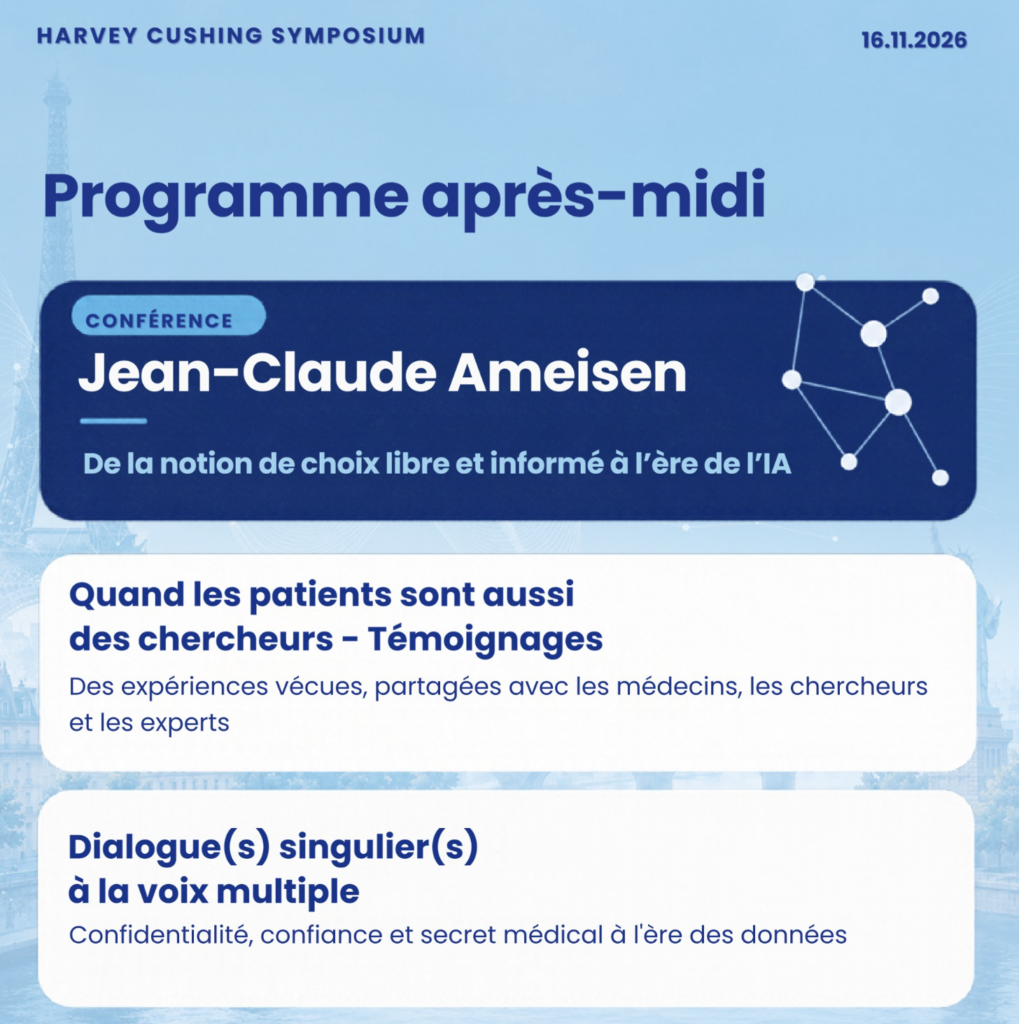
Conférence – De la notion de choix libre et informé à l’ère de l’IA/ Conference – On the Notion of Free and Informed Choice in the Age of AI
Modérateur / Chair Gérard Friedlander, MD, PhD Ancien doyen de la faculté de médecine René Descartes ; délégué général de la Fondation Université Paris Cité./Former Dean of the René Descartes Medical School; Delegate General at the Université Paris Cité Foundation.
Intervenant / Speaker
Jean-Claude Ameisen, MD, PhD Président d’honneur du Comité consultatif national d’éthique (CCNE)./Honorary Chair of the National Consultative Ethics Committee (CCNE).
- 14h30-15h15 Quand les patients sont aussi des chercheurs – TémoignagesWhen Patients Are Researchers Too – Personal TestimoniesIntervenants / Speakers
- Luigi Flora, PhD, Patient-chercheur.Patient-researcher.
- Fabienne Hejoaka, PhDAnthropologue de la santé, Institut de recherche pour le développement (IRD).Health anthropologist, French National Research Institute for Sustainable Development (IRD).
- Jean-François ThébautVice-président chargé du plaidoyer, Fédération française des diabétiques.Vice-President for Advocacy, French Diabetes Federation.
- Samuel H. Selesnick, MD, FACSProfesseur d’oto-rhino-laryngologie et de chirurgie cervico-faciale, Weill Cornell Medicine.Professor of Otolaryngology–Head and Neck Surgery, Weill Cornell Medicine.
15h15-16h00
Dialogue(s) singulier(s) à la voix multiple
Unique Dialogue(s) with Multiple Voices
Le cabinet médical a longtemps été le sanctuaire du secret partagé entre un patient et son médecin ; mais à l’heure de l’IA, des dossiers numériques et des plateformes de santé, ce secret tient-il encore ? Éthiciens, médecins de santé publique et acteurs de la transformation numérique confrontent leurs points de vue sur ce qui se joue dans l’espace le plus intime de la médecine. Une table ronde pour interroger les nouvelles frontières de la confidentialité, de la confiance et du secret médical à l’ère des données./ The doctor’s office has long been the sanctuary of a shared secret between patient and physician — but in the age of AI, digital records, and health platforms, does that secret still hold? Ethicists, public health physicians, and digital health leaders discuss what is really at stake in medicine’s most intimate space. A panel to challenge the new boundaries of confidentiality, trust, and medical privacy in the data age.
Modérateur / Chair : Arnold Munnich, MD, PhD, Pédiatre, généticien et président de la Fondation Imagine/ Pediatrician, geneticist and President of the Imagine Foundation.
Intervenants / Speakers
- Marie-France Mamzer, MD, PhDProfesseure d’éthique médicale et de médecine légale à Université Paris Cité et praticienne hospitalière à l’hôpital Necker–Enfants malades.Professor of Medical Ethics and Forensic Medicine at Université Paris Cité and physician at Necker–Enfants malades Hospital.
- Philippe Caillet, MDPraticien hospitalier en gériatrie, consultation d’évaluation oncogériatrique, hôpital européen Georges-Pompidou et hôpital Corentin-Celton, AP-HP.Hospital physician in geriatric medicine, geriatric oncology assessment clinic, Georges-Pompidou European Hospital and Corentin-Celton Hospital, AP-HP.
- Corinne Catarozoli, PhDResponsable de la santé mentale pédiatrique et professeure associée de psychologie en pédiatrie clinique, Weill Cornell Medicine.Section Chief, Pediatric Mental Health; Associate Professor of Psychology in Clinical Pediatrics, Weill Cornell Medicine.
- Anjana Jagpal, PhDPsychologue et professeure assistante de psychologie en psychiatrie clinique et en pédiatrie à Weill Cornell Medicine.Psychologist and Assistant Professor of Psychology in Clinical Psychiatry and Pediatrics at Weill Cornell Medicine.
16h00-16h30
Conclusions/ Closing remarks avec Benoit Gallix, MD, PhDDirecteur général de l’Hôpital Américain de Paris.Chief Executive Officer, American Hospital of Paris.